Package Overview
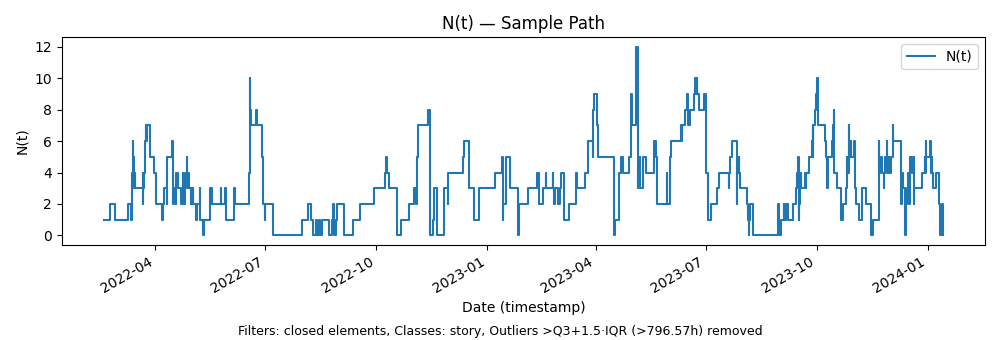
Sample Path Analysis
This library implements sample path analysis, a technique for analyzing macro dynamics of flow processes in complex adaptive systems. It provides deterministic tools to analyze the long-run behavior of stochastic flow processes:
- Arrival/departure equilibrium
- Process time coherence, and
- Process stability
The relies on the finite-window formulation of Little’s Law.
The focus of the analysis is a single sample path of a flow process: a continuous real-valued function that describes a particular process behavior when observed over a long, but finite period of time (see figure).
A key aspect of this technique is that it is distribution-free. It does not require well-defined statistical or probability distributions to reason rigorously about a flow process. Please see sample path analysis is not a statistical method for more details.
As a result, this technique allows us to extend many results from stochastic process theory to processes operating in complex adaptive systems, where stable statistical distributions often don’t exist. Our focus is operations management in software development, but the techniques here are much more general.
History and Origins
Sample path analysis is not new. The formal theory has been worked out thoroughly by researchers in stochastic process theory and has been stable for over 30 years. They are just not familiar in the software industry.
Dr. Shaler Stidham discovered the technique when he provided the first deterministic proof of Little’s Law in 1972. So the core ideas here are nearly 60 years old!
In the years since Dr. Stidham and other researchers in stochastic process theory have shown the power and versatility of this technique to provide deterministic sample path oriented results of many classical results in queueing theory that required very stringent probabilistic assumptions like stationarity and ergodicity to prove previously.
The canonical reference detailing this work is the textbook Sample Path Analysis of Queueing Systems by Muhammed El-Taha and Shaler Stidham (a downloadable PDF is available at the link). This package directly implements many of the concepts in this textbook.
See our article on Little’s Law for comprehensive background and source references.
Why this is significant
Conditions like non-stationarity and non-ergodic behavior and lack of stable distributions are exactly the dividing line between complex adaptive systems and simpler, ordered systems when viewed from an operations management lens.
This is the situation we face in digital operations management. The default assumptions that underpin operational analysis in ordered domains – that processes are stable and that steady state behavior can be observed and analyzed – breaks down in this environment.
Sample path analysis allows us to adapt these principles to processes that operate far from equilibrium and whose behavior is history sensitive, path dependent and sensitive to initial conditions. All these are hallmarks of a CAS.
There are several capabilities we get from this:
- We can precisely define, measure and reason about properties such as equilibrium, coherence and stability, of real-world process using transaction data from operations management tools.
- We can retrospectively reason about cause and effect in observed behavior of these operational processes, and do so in a deterministic fashion - even for process that are not stable.
These are precisely the conditions that confound traditional statistical and probabilistic reasoning about operational processes in the digital domain. Thus sample path analysis is the technical bridge to rigorously model and measure flow processes in such contexts.
Key Concepts
Please see our continuing series on Little’s Law and sample path analysis at The Polaris Flow Dispatch for accessible overviews of the theory.
In particular,
cover most of the background needed to work with this library at a high level.
The example analyses in these posts were produced using this library and can be found in the examples directory together with their original source data.
Please subscribe to The Polaris Flow Dispatch if you are interested in staying abreast of developments and applications of these concepts.
Flow processes
A flow process is simply a timeline of events from some underlying operational domain, where events have effects that persist beyond the time of the event. The effects are encoded using metadata (called marks) to describe them. The generality of the model comes from the fact that marks can be arbitrary real-valued functions of time that meet some very weak requirements.
Typically data for analyzing a flow process are extracted from real-time transaction logs of digital operations management tools.
The current version of the library only supports the offline analysis of binary flow processes. These are flow processes where the marks denote the start or end of an observed presence of a domain element within some system boundary.
All queueing processes fall into this category, as do a much larger class of general input-output processes. These are the simplest kind of flow processes we analyze in the presence calculus, but they cover the vast majority of operational use cases we currently model in software delivery, so we will start there. They are governed by the L=λW form of Little’s Law.
We highly recommend reading The Many Faces of Little’s Law for background on these concepts.